
For a developer or contractor, choosing a cement is more than comparing prices.
There are several elements that influence concrete performance. It includes climate, soil chemistry, construction practices, and long-term exposure conditions.
In practice, here’s what you need to know:
- Choose OPC for fast-track projects and heavy-load structural work.
- Choose PCC for residential and coastal construction works.
In the nationwide cement market, there are only two commonly used cement types.
It is Ordinary Portland Cement (OPC) and Portland Composite Cement (PCC). Both of the cement products comply with national standards.
Nonetheless, their behavior is different in construction environments.
In this guide, we explain how OPC and PCC work.
We also discuss their comparative performance in Bangladeshi conditions. By the end, you can decide which option is suitable for the project you are working on.
What is OPC?
Ordinary Portland Cement (OPC) is manufactured via grinding clinker with a small amount of gypsum.
The clinker is formed by heating limestone and clay at high temperatures.
OPC is known for its high early strength.
Concrete made with OPC gains strength quickly within the first 3 to 7 days. This allows fast formwork removal and quick progress for the project.
In Bangladesh, OPC is commonly used for heavy-load construction projects. It includes bridges, RCC roads, flyovers, and precast elements. These projects require early load-bearing capacity and need to be completed within a strict timeline.
Nonetheless, OPC produces high heat during hydration. In hot weather, it increases the risk of thermal cracking in mass concrete pours (ACI 207).
At the same time, OPC has lower inherent resistance to sulfate and chlorides unless formulated. This acts as a limitation in coastal and flood-prone regions (ASTM C150).
What is PCC?
Portland Composite Cement (PCC) is a blended cement.
It consists of clinker, gypsum, and other supplementary cementitious materials. It includes fly ash, slag, or limestone.
These additions have an impact on how cement behaves. In general, PCC produces less heat during the hydration process. In comparison to OPC, strength develops slower at early stages. But, it continues to gain strength over time.
PCC’s behavior is suitable for Bangladesh.
A lower heat reduces cracking in warm and humid conditions.
Improved chemical resistance helps concrete to withstand sulfate-rich soil and saline groundwater. It is highly applicable for coastal districts like Khulna, Barisal, and Cox’s Bazar (BS EN 197-1).
Moreover, PCC supports sustainable construction. Annually, cement production contributes 7-8% of the global carbon emissions. But using blended cement significantly lowers this impact.
Today, PCC is widely used for various construction works across Bangladesh. It includes residential buildings, foundations, slabs, and mass concrete. Here, durability and long service life are first priorities.
OPC vs PCC: Comparison for Bangladesh
| Factor | OPC | PCC |
| Raw Materials | Clinker and gypsum | Clinker, gypsum, fly/ash/slag/limestone |
| Clinker Content | 95-100% | 65-94% |
| Heat of Hydration | High | Low |
| Early Strength | High (3-7 days) | Moderate (7-10 days) |
| Long-Term Strength | Stable | Increases over time |
| Workability | Moderate | Higher and more consistent |
| Durability | Moderate | High |
| Sulfate Resistance | Lower | Higher |
| Chloride Resistance | Lower | Higher |
| Common Grades | 32.5, 42.5, 52.5 | 32.5, 42.5 |
| Cost Per Bag | 480 tk – 540 tk | 490 tk – 520 tk |
| Typical Application | Bridges, RCC roads, precast | Housing, coastal works and mass concrete |
For Bangladesh, PCC performs best in humid, saline and high-temp environments.
However, OPC is the common choice for local developers and contractors. It is most suitable for construction projects which require early strength in a fast timeline.
Choose Tiger OPC and PCC Cement
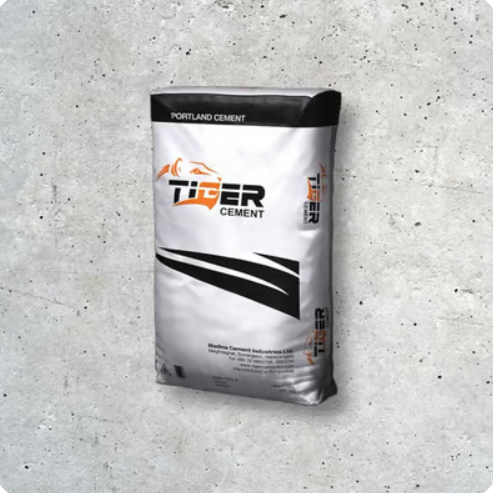
Tiger Ordinary Portland Cement (OPC)
Tiger Ordinary Portland Cement (OPC) is built for high-strength and high-demand construction.
The cement product complies with BDS EN 197-1:2003 CEM I and 52.5 N standards.
Thus, it is a perfect choice for critical structural applications across Bangladesh.
Tiger OPC supports construction where the timeline is crucial.
A faster setting means earlier formwork removal.
It is essential for infrastructure projects in urban centers of Dhaka and Chittagong. A simple delay can significantly increase overall costs for developers and contractors.
Controlled alkali and chloride levels reduce reinforcement corrosion risk.
This is an important aspect for Bangladesh’s humid environment. Here, moisture exposure can accelerate steel degradation over time.
Here are Tiger OPC’s numerical performance figures:
- Compressive strength: 52.5 N/mm² at 28 days
- Setting time: ~20% faster than conventional OPC
- Concrete lifespan improvement: up to 25%
- Density: 1,400–1,500 kg/m³
- Coverage: ~10% more per bag
- Water demand reduction: 8–10%
- Cement consumption reduction: up to 15% per m³
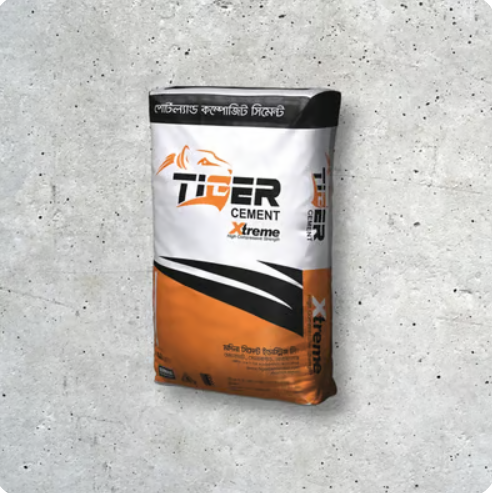
Tiger Portland Composite Cement (PCC A-M)
Tiger PCC is manufactured for Bangladesh’s climate and soil conditions. It focuses on long-term durability for an environment that is exposed to moisture, heat, and chemical attack.
The blended composition of the cement product reduces permeability. Thus, it limits the chloride and sulfate penetration. It is critical for structures based in coastal belts and flood-prone regions.
A lower thermal absorption helps to manage curing stress in hot conditions.
This reduces the possibility of cracking risk in slabs, foundations, and mass concrete. These elements are commonly used in Bangladeshi construction.
In terms of Tiger PCC, there is an environmental advantage. A reduced clinker content lowers carbon emissions. At the same time, it helps to maintain structural performance.
OPC vs PCC: Which Is Better for Bangladesh?
There is no single cement that fits every construction in Bangladesh or abroad. The choice depends on various factors. At Tiger Cement (formerly known as Medina Cement), we offer both OPC and PCC.
It includes environmental exposure, scale of work, and timeline.
In Bangladesh, the warm climate accelerates hydration reactions. In addition to high humidity, this increases cracking risk in high-heat cement systems.
PCC solves this problem by producing lower hydration heat. Therefore, it becomes a safer bet in typical Bangladeshi weather (ACI 207).
Another factor is soil chemistry.
Many regions in the country consist of sulfates and chlorides. It attacks the concrete over time. PCC’s blended material helps to improve chemical resistance. It extends the structural lifespan in coastal and flood areas (ASTM C595).
However, OPC remains vital for specific needs. Many major infrastructure projects require early strength. For instance, precast yards, flyovers, and heavy-load RCC structures. They benefit from OPC’s rapid strength.
From a cost perspective, PCC offers better lifecycle value.
The cement product offers slower early strength, reduced cracking, and lower permeability. Also, improved durability helps to lower long-term maintenance and repair costs.
At the same time, sustainability is becoming an important aspect for the cement industry. PCC’s blended materials support lower carbon construction.
Most importantly, it aligns with modern infrastructure development goals (IEA).
Related Article:
- Cement Pricing Bangladesh – 2026
- Budgeting for Cement in Construction Projects in Bangladesh
- Top Cement Companies in Bangladesh – 2026
OPC and PCC for Bangladesh: FAQs
Is PCC weaker than OPC in Bangladesh?
No. PCC gains strength slowly. But, long-term strength equals or exceeds OPC (BS EN 197-1).
Which Cement is Better for Coastal Areas in Bangladesh?
PCC performs better due to high sulfate and chloride resistance (ASTM C595).
Can OPC Be Used for Houses in Bangladesh?
Yes, it can be. PCC provides better durability and lower maintenance.
Does PCC Reduce Cracking in Bangladesh?
Yes. A lower heat hydration reduces thermal cracking in warm conditions (ACI 207).
Is PCC More Environmental Friendly Option in Bangladesh?
Yes. PCC’s reduced clinker content lowers carbon emissions significantly (IEA).
References:
- BDS EN 197-1 – Cement: Composition, Specifications and Conformity Criteria
https://www.bds.gov.bd/site/page/standards (Bangladesh Standards and Testing Institution – BSTI / BDS standards portal) - ASTM C150 – Standard Specification for Portland Cement
https://www.astm.org/c0150_c0150m.html - ASTM C595 – Standard Specification for Blended Hydraulic Cements
https://www.astm.org/c0595_c0595m.html - ASTM C1012 – Sulfate Resistance of Hydraulic Cement Mortars
https://www.astm.org/c1012_c1012m.html - ACI 207 – Guide to Mass Concrete
https://www.concrete.org/store/productdetail.aspx?ItemID=207R16 - ACI 222 – Protection of Metals in Concrete Against Corrosion
https://www.concrete.org/store/productdetail.aspx?ItemID=222R01 - International Energy Agency (IEA) – Cement Technology Roadmap
https://www.iea.org/reports/cement - Bangladesh Water Development Board (BWDB) – Soil & Groundwater Salinity Data: https://bwdb.gov.bd
- https://www.bwdb.gov.bd/index.php/site/page/Salinity