
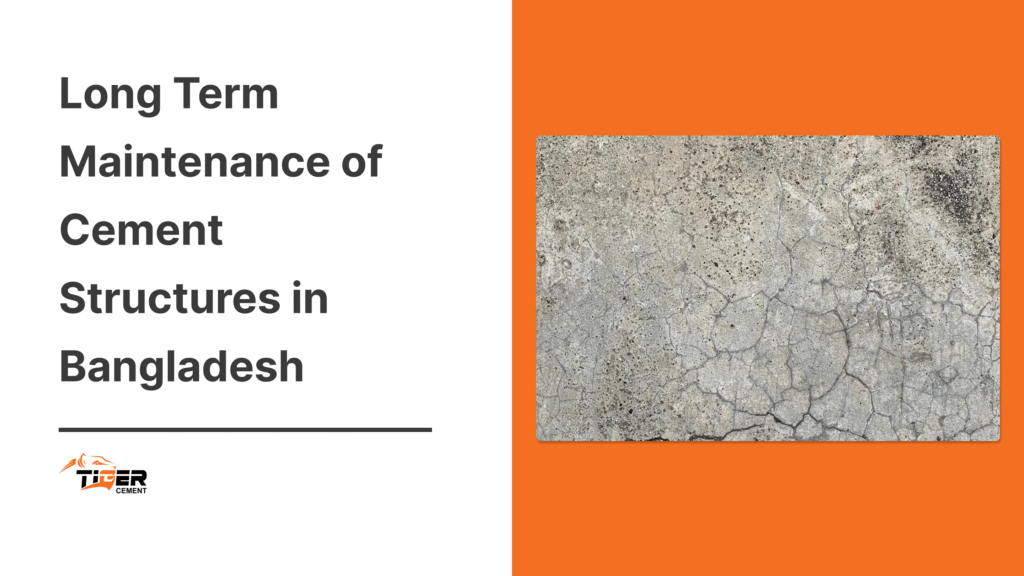
Cement structures are the backbone of modern Bangladesh.
All infrastructures rely on concrete. Public or private structures carry the nation’s growth. But construction is not the end of the story.
The durability of these structures depends on their maintenance. Without long-term care, the concrete loses strength. Thus, cracks form over time and steel reinforcement corrodes. Hence, the entire building becomes unsafe for the people.
In Bangladesh, the difficulty and risk are higher. The climate is harsh, and the population is dense. At the same time, building practices are inconsistent.
For these reasons, long-term maintenance of cement is more than a technical issue. It is about safety, cost savings, and sustainable development for all the structures.
Common Challenges for Cement Structures in Bangladesh
Climate and Environmental Factors
Bangladesh consists of a tropical and monsoon-driven climate. It imposes severe stress on the concrete. The coastal regions battle with chloride-laden air and seawater intrusion.
This reinforces the concrete corrosion. At the same time, exposure to flooding and cyclonic events accelerates the process of structural wear.
Material Quality Issues
Durability of cement structures starts with material selection.
The experts recommend a minimum concrete strength of 4,000 psi (water-cement ratio ≤ 0.45)—at least 5,000 psi (water-cement ratio ≤ 0.40) for saline or coastal environments.
Brick chips are discouraged due to high porosity. Instead, washed and well-graded stone aggregates are much preferred. At the same time, admixtures are crucial for improving durability (The Daily Star).
Alarmingly, only 5 percent of concrete used in Bangladesh meets the durability standards. Unfortunately, the rest is compromised. It is mainly due to poor knowledge and experience. Thus, it reduces the 100-year life span expectancy to 30 years.
Construction Practices and Human Factors
In many projects, we have noticed unfamiliar practices. It includes aggressive watering, poor curing, and a lack of supervision, which affects the project’s outcome.
As a matter of fact, many engineers only tend to inspect up to the sixth floor in construction sites. Beyond that, the masons often work unsupervised. Thus, increasing the risk of defects.
Studies have shown that high water-cement ratios and dusty aggregates increase porosity and carbonation rate. In a few years, the carbonation can reach the steel reinforcement. As a result, it triggers the acceleration of corrosion under high humidity and temperature.
Urbanization, Overloading, and Regulations
In Old Dhaka, 687 buildings have been identified as vulnerable to collapse. Among them, 165 are at risk due to age and structural weakness.
Compared to the U.S. and Japan, Bangladesh’s reinforced concrete structures are estimated to be 3 to 5 times more vulnerable to collapse (Dhaka Tribune).
It is alarming, considering Bangladesh lies in a seismically active region. A primary reason is poor compliance with building codes.
Unfortunately, tragic industrial disasters display the result of weak construction and maintenance. The Rana Plaza collapse in 2013 claimed over 1,130 lives. Before this event, the Spectrum garment collapse 2005 resulted in 73 deaths (Wikipedia).
Key Long-Term Maintenance Strategies
Regular Inspections and Structural Audits
At Tiger Cement, we recommend mandatory inspection every 3-5 years. It is highly applicable for high-risk and high-rise structures.
It can help detect early signs of deterioration before any failure occurs. By implementing such audits, we can minimize the risk of failure in both private and public buildings.
Surface Protection Methods
Protective layers such as sealants, waterproof coatings, and anti-saline treatments are indispensable. In the coastal zones, slag-based cement is suggested for use.
It can help to reduce chloride ingress and improve durability. Studies have shown that concrete can last over 150 years only if designed with proper cover, a low water-cement ratio, and quality materials.
Crack Detection and Repair
Corrosion of reinforcement does happen due to carbonation or chloride ingress. It causes rust to expand 6-8 times its original volume. This leads to surface cracking and spalling.
A small crack can speed up the property’s deterioration process. Failing concrete chunks can cause serious injuries and damage if not detected earlier.
Corrosion Prevention for Steel Reinforcement
We recommend using epoxy-coated, stainless steel rebars or corrosion inhibitors. It ensures maximum concrete cover depth. Ultimately, it helps shield the reinforcement from moisture and chloride attack.
Strengthening and Retrofitting Techniques
You can retrofit aging structures using FRP wrapping and jacketing. External support is often more cost-effective and safer than demolition and rebuilding.
Best Practices for Maintenance in Bangladesh
Use of Durable Materials
The first defense for a construction project is material choice. Slag-modified cement, low-cement water ratios, clean aggregates, and chemical admixtures help to resist decay.
Training for Workers and Supervisors
Not having the proper knowledge and experience is costly. Training masons and site supervisors reduces the possibility of errors. A skilled team is more likely to follow the right procedure. It includes correct mixing ratios, proper curing, and repair protocols.
Government Regulations and Building Codes
Bangladesh has a national building code. However, the enforcement is not consistent. There needs to be stronger rules and regulations. If not followed, strict action should be taken. We believe periodic inspections and certifications should be mandatory for all large structures.
Preventive Measures for Homeowners
When it comes to making a positive change, even homeowners can play a role in it. It is not only applicable to construction companies.
A homeowner can take some simple actions to prolong their property’s life. It includes sealing roofs, applying waterproof coatings, installing a proper drainage system, inspecting walls for dampness, and many more.
Case Studies
Padma Bridge
The Padma Bridge displays how proper and detailed planning improves durability.
This national project used high-quality materials, modern design, and advanced construction methods. These measures help the bridge withstand strong wave currents and floods. All in all, Padma Bridge is a model for future projects.
Residential Buildings in Old Dhaka
Here, Old Dhaka provides the opposite picture to Padma Bridge.
Apartment blocks are poorly built and maintained. The area is overcrowded with unplanned modifications. A lack of inspection for decades has left the buildings in dangerous conditions. The authorities have already marked hundreds of buildings in Old Town as unsafe (Daily Star).
Future Outlooks for Cement Structure Maintenance
As time passes, technology is creating new opportunities for the construction industry.
For instance, smart sensors are installed in concrete. It helps to monitor crack, stress, and moisture in real time. Though expensive today, self-healing concrete may one day seal minor cracks automatically.
Government initiatives are also important. More investment is needed in training workers. Also, implement stricter codes and collaborate with developers.
If Bangladesh wants to reach its development goals by 2041, maintaining infrastructure should be a national priority. At Tiger Cement, we will play our role actively.
References:
- ResearchGate. (2015). The corrosion performance of steel and reinforced concrete in a tropical humid climate: A review.
- The Daily Star. (2018). Sustainable development demands durable concrete.
- The Daily Star. (2018). Flaws in concrete weaken structures: Analysts.
- UAP BD. (2005). Sustainable Construction Practices for Bangladesh: A Study.
- Dhaka Tribune. (2016). Faulty construction blamed for building collapses in Dhaka.
- Wikipedia. (2023). Rana Plaza collapse.
- The Daily Star. (2019). Durability of concrete: Health and safety related issues.
- The Daily Star. (2019). Construction materials and safe construction practice for corrosion-prone areas.
- The Daily Star. (2019). Durability of Concrete: Health and Safety Issues.